

Forex trading is the largest financial market in the world, with over $6 trillion traded daily. Unlike stocks or crypto, the Forex market operates 24 hours a day, offering traders constant opportunities—but also constant risk.
At the core of successful trading is not just strategy, but infrastructure. Before placing a single trade, professionals take time to choose a trading platform that ensures reliable execution, low spreads, and stable performance. Without the right platform, even the best strategy can fail.
In this article, we’ll break down Forex trading in a practical, real-world way—from how the market works to strategies, risk management, and the psychology behind consistent results.
What Is Forex Trading?
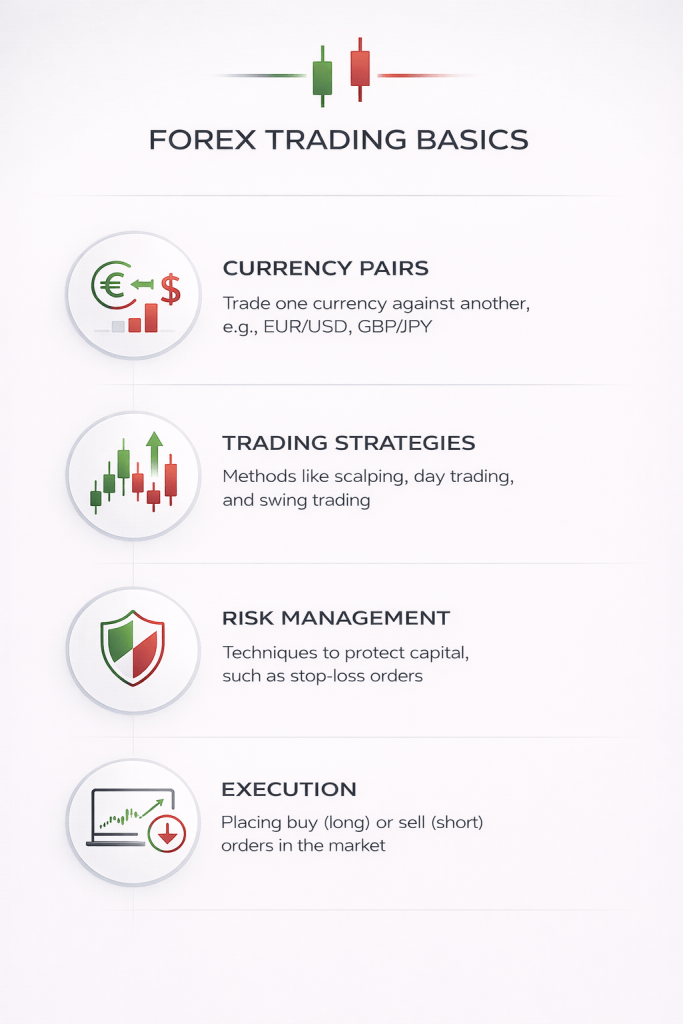
Forex (foreign exchange) trading involves buying one currency while selling another. Currencies are traded in pairs.
Examples of Currency Pairs
- EUR/USD — Euro vs US Dollar
- GBP/USD — British Pound vs US Dollar
- USD/JPY — US Dollar vs Japanese Yen
If you believe the euro will strengthen against the dollar, you buy EUR/USD. If you expect it to weaken, you sell.
How the Forex Market Works
Unlike centralized exchanges, Forex operates over-the-counter (OTC).
Key Participants
- Banks
- Hedge funds
- Corporations
- Retail traders
Prices are driven by supply and demand, influenced by economic data, interest rates, and global events.
Major Forex Sessions
| Session | Main Market | Volatility |
|---|---|---|
| Asian | Tokyo | Low to moderate |
| European | London | High |
| US | New York | High |
The most active periods occur when sessions overlap.
Key Concepts Every Trader Must Understand
1. Pips
The smallest price movement in a currency pair.
2. Leverage
Allows traders to control larger positions with less capital—but increases risk.
3. Spread
The difference between buy and sell prices.
4. Margin
The amount required to open a position.
Forex Trading Strategies
There is no single “best” strategy. Success comes from consistency.
1. Trend Following
- Trade in the direction of the trend
- Use moving averages
- Avoid counter-trend setups
2. Scalping
- Short-term trades
- Small profits per trade
- High frequency
3. Swing Trading
- Hold positions for days
- Capture larger moves
4. Breakout Trading
- Enter when price breaks key levels
- Focus on volatility
| Strategy | Timeframe | Risk Level |
|---|---|---|
| Scalping | Minutes | High |
| Day Trading | Hours | Medium |
| Swing Trading | Days | Lower |
Risk Management: The Real Edge
Most traders fail not because of bad strategies, but because of poor risk control.
Core Rules
- Risk no more than 1–2% per trade
- Always use stop-loss
- Avoid overleveraging
A single bad trade should never wipe out your account.
The Importance of Choosing the Right Platform
Your trading platform is your execution engine.
Key Factors
| Factor | Why It Matters |
|---|---|
| Execution speed | Reduces slippage |
| Spreads | Impacts profitability |
| Reliability | Prevents missed trades |
| Tools | Supports analysis |
A poor platform can turn a profitable system into a losing one.
Psychology of Forex Trading
Trading is as much psychological as it is technical.
Common Emotional Traps
- Fear of missing out (FOMO)
- Revenge trading
- Overconfidence
Discipline separates professionals from beginners.
Common Mistakes Traders Make
- Overtrading
- Ignoring risk management
- Switching strategies too often
- Using unreliable platforms
Consistency matters more than complexity.
Forex vs Other Markets
| Market | Liquidity | Volatility | Hours |
|---|---|---|---|
| Forex | Very high | Moderate | 24/5 |
| Stocks | High | Variable | Limited |
| Crypto | High | Very high | 24/7 |
Each market has its own characteristics.
Developing a Trading Plan
A trading plan is essential for consistency.
Key Elements
- Entry rules
- Exit rules
- Risk management
- Performance tracking
Without a plan, trading becomes gambling.
The Role of Discipline
Discipline is the foundation of long-term success.
It means:
- Following your strategy
- Managing emotions
- Sticking to risk limits
Final Thoughts: Trading as a Skill
Forex trading is not a shortcut to quick money—it’s a skill that takes time to develop.
The most successful traders:
- Focus on process, not profit
- Control risk
- Continuously improve
Because in the end, trading is not about predicting the market.
It’s about managing yourself within it.